Joven, Alpha, Rinnai, Panasonic, Elba — every brand sold in Malaysia advertises 8 to 10 year unit lifespans. Across hundreds of replacement jobs in Shah Alam, the honest average we see is closer to 5 to 7. Same brands, same installer-quality, ostensibly same conditions. Why the gap?
The brochures aren't lying — they're just measuring under ideal conditions. The Klang Valley's humidity, water chemistry and installation shortcuts shave years off in practice. Here's what's actually going wrong.
Malaysian bathrooms run 70–90% relative humidity for most of the year. That humidity gets inside the heater casing through cable glands and ventilation slots. Over 3–5 years, it corrodes the heating element from the outside in — even when the element itself isn't touching water.
The first sign is RCD tripping: the element develops microscopic earth-leakage faults. The heater itself is mechanically fine; the element just can't hold insulation anymore. Element replacement fixes it for around a third of the cost of a new unit.
Klang Valley water carries 80–150 ppm hardness depending on which treatment plant supplies your area. That's borderline-hard. Inside a storage heater, calcium and magnesium scale precipitates onto the heating element over time, insulating it from the water.
Insulated element = harder work = hotter element shell = faster failure. We've pulled elements with three-millimetre scale crusts from heaters that were only six years old.
What helps: A whole-house sediment filter with periodic cartridge changes drops scale dramatically. So does descaling the tank annually if you're on a storage unit.
Older Shah Alam terraces were built when bathroom electrical demand was minimal. The cable feeding the heater socket is often 1.5mm² — fine for a fan and lights, marginal for a 3,000W heater. Marginal feeds run hot, age cable insulation, and create high-resistance points that stress the heater on every cycle.
What helps: Confirm with an electrician that the heater is on a dedicated 2.5mm² circuit with an RCD rated for the load. We often coordinate this when we do an install.
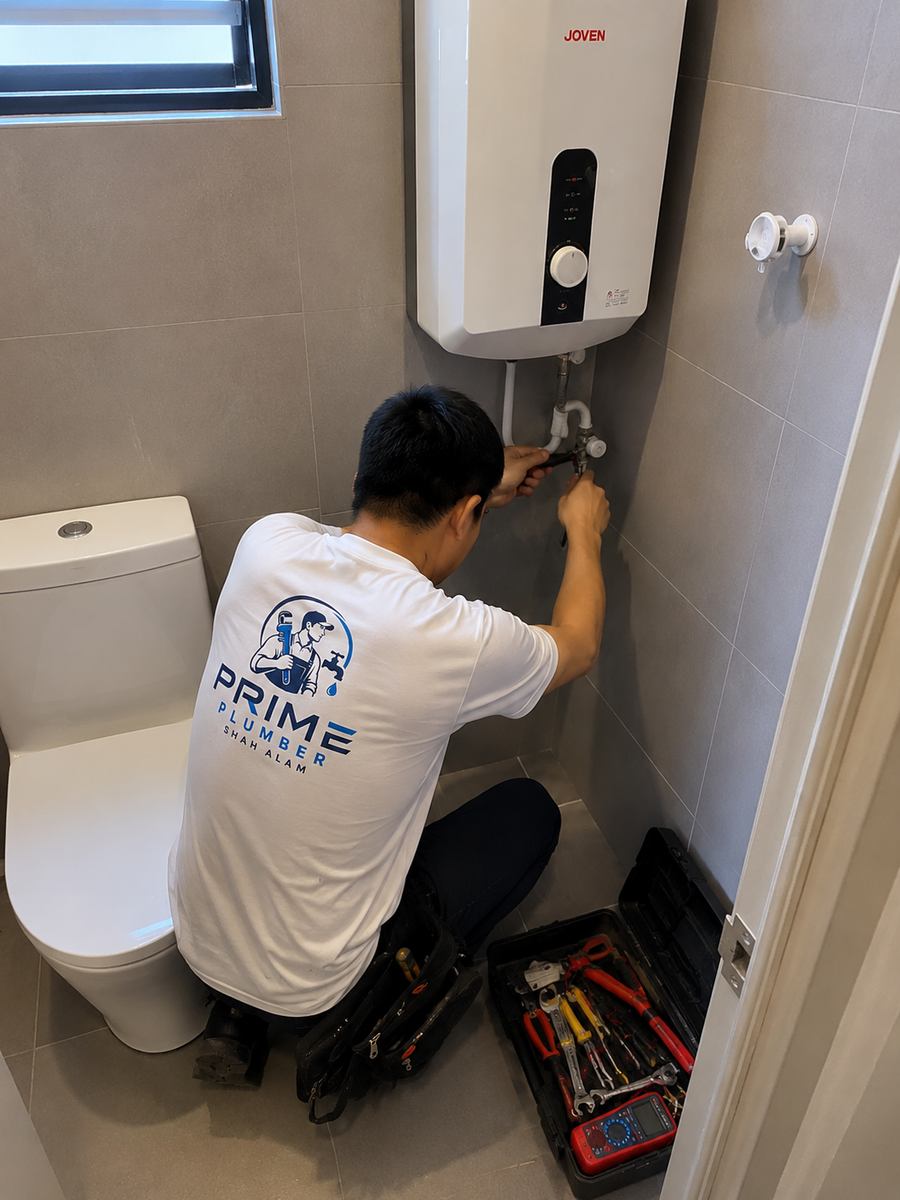
A proper instant-heater install includes a temperature-pressure relief valve and a drain line to outside the bathroom. Half the units we replace don't have this. When the unit overheats (which it eventually does), the relief valve fires inside the bathroom, the casing fills with water, and everything inside fries.
You can spot a missing drain line by looking at the relief valve port — if there's no pipe leaving the unit and routed somewhere safe, the install was cheap. Proper installs always include this.
This one's specific to coastal-influenced humidity. When the heater cycles cold-to-hot, condensation forms inside the casing. In Shah Alam (about 25km inland), the air carries trace salt that deposits on circuit boards. Over years, this corrodes contacts on the thermostat and pressure switch.
What helps: Keep the bathroom ventilated. An exhaust fan running during showers makes a measurable difference to heater longevity.
If your heater is already past 5 years and giving you trouble, get it diagnosed before replacing it. Element + thermostat together cost less than a new unit and buy you another 4–5 years. WhatsApp us a photo of the unit and we'll quote.
WhatsApp us a photo and we'll tell you what it'll cost to fix.